

Global Acute Agitation and Aggression Treatment Market Amid Rising Psychiatric Emergencies, Expanding Mental-Health
Acute Agitation and Aggression Treatment Market Size
Acute Agitation and Aggression Treatment Market 2025–2033: Emerging Therapies & Growth Forecast
United States Acute Agitation and Aggression Treatment Market Outlook 2025–2032: Pharma Innovations & Strategies”
AUSTIN, TX, UNITED STATES, February 10, 2026 /EINPresswire.com/ -- AUSTIN, Texas and TOKYO, February 10, 2026: The global acute agitation and aggression treatment market is witnessing steady growth, supported by the rising prevalence of psychiatric and neurological disorders, increasing emergency department visits related to behavioral disturbances, and expanding access to essential psychiatric medicines across both developed and emerging healthcare systems. — DataM Intelligence 4Market Research LLP
According to data from the World Health Organization (WHO), schizophrenia affects about 24 million people globally, while bipolar disorder affects nearly 40 million people, both of which are commonly associated with agitation episodes requiring pharmacologic intervention.
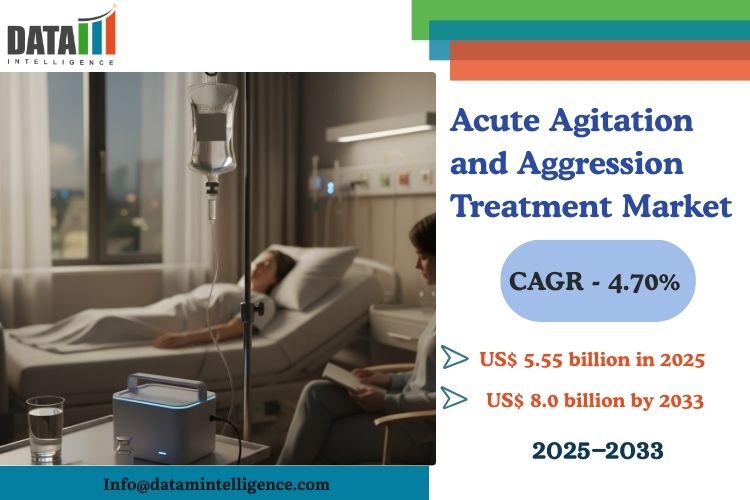
The market was valued at approximately US$ 5.55 billion in 2025 and is projected to reach US$ 8.0 billion by 2033, expanding at a CAGR of 4.70% during the forecast period, driven by growing mental-health awareness, improved diagnosis rates, and increasing adoption of rapid-acting antipsychotics and sedative formulations in emergency and inpatient care settings.
Increasing psychiatric hospital admissions, growing prevalence of schizophrenia, bipolar disorder, and dementia-related agitation, and wider availability of rapid-acting antipsychotics and sedatives are propelling the global acute agitation and aggression treatment market, supported by improving emergency care capacity and broader access to cost-effective generic CNS medicines.
Growth is further supported by broader public-health and healthcare system trends aimed at strengthening behavioral health infrastructure and improving access to psychiatric care. The WHO reports that more than 55 million people worldwide are living with dementia, a significant proportion of whom experience agitation and aggression during disease progression, creating sustained demand for effective acute management therapies.
In addition, increasing availability of cost-effective generic antipsychotics and benzodiazepines, expansion of hospital pharmacy networks, and integration of standardized agitation-management protocols in emergency medicine are improving treatment accessibility. The continued expansion of mental-health programs, public-health funding initiatives, and hospital capacity for psychiatric and neurological care is reinforcing the role of pharmaceutical manufacturers and healthcare providers as key contributors to the global acute agitation and aggression treatment market.
Increasing Emergency Department Visits and Behavioral Health Admissions Driving Treatment Demand
The rising number of emergency department (ED) visits related to mental and behavioral health conditions is a key driver for the acute agitation and aggression treatment market, as acute agitation is frequently managed in emergency settings. According to the U.S. Agency for Healthcare Research and Quality (AHRQ), mental and substance-use–related disorders account for over 12 million emergency department visits annually in the United States, representing a significant volume of cases requiring rapid pharmacological stabilization and short-term sedation in acute care environments. The high reliance on ED-based psychiatric care continues to increase utilization of injectable antipsychotics and benzodiazepines.
This trend is reinforced by the broader global burden of mental health disorders. The World Health Organization (WHO) estimates that approximately 1 in every 8 people worldwide, nearly 970 million individuals, live with a mental disorder, many of which can involve episodes of severe agitation or aggression during acute exacerbations. The growing patient pool, combined with increasing hospital admissions for psychiatric crises and substance-related behavioral disturbances, is driving sustained demand for fast-acting agitation management therapies across both developed and emerging healthcare systems.
Benzodiazepines Drug Class Segment Drives Demand in the Global Acute Agitation and Aggression Treatment Market
Demand for the benzodiazepines drug class in the acute agitation and aggression treatment market remains strong due to their rapid onset of action and effectiveness in calming severe agitation, alcohol withdrawal, and substance-induced behavioral disturbances, particularly in emergency departments.
According to the U.S. Substance Abuse and Mental Health Services Administration (SAMHSA), there are over 5 million drug-related emergency department visits annually in the U.S., many involving agitation or anxiety symptoms where benzodiazepines such as lorazepam or midazolam are commonly used for short-term stabilization.
In addition, clinical emergency medicine studies indicate that benzodiazepines are used in a significant proportion of acute agitation cases, particularly when agitation is related to intoxication or withdrawal, reinforcing their role as a first-line or adjunct therapy. The growing burden of substance use disorders and increasing hospital-based psychiatric emergencies continue to sustain demand for injectable and fast-acting benzodiazepine formulations globally.
Asia-Pacific Emerges as a Major Demand Center for Acute Agitation and Aggression Treatment Driven by Rising Mental-Health Burden and Expanding Healthcare Access
Asia-Pacific is witnessing increasing demand for acute agitation and aggression treatment due to the growing burden of mental and neurological disorders and expanding hospital infrastructure. The World Health Organization (WHO) estimates that nearly 260 million people in the South-East Asia Region are living with mental health conditions, creating a large patient pool requiring psychiatric and emergency care services.
Get a Sample PDF Of This Report (Get Higher Priority for Corporate Email ID):– https://www.datamintelligence.com/download-sample/acute-agitation-and-aggression-treatment-market
Governments across countries such as India, China, and Thailand are expanding public healthcare coverage and strengthening hospital networks, which is improving access to essential psychiatric medicines, including antipsychotics and sedatives used for agitation management.
According to India’s National Health Authority, hospital admissions under the Ayushman Bharat scheme surpassed 60 million cumulative treatments by 2024, reflecting the rapid expansion of inpatient care capacity, including psychiatric and emergency services.
The region is also growing due to its strong pharmaceutical manufacturing base and increasing production of generic CNS drugs. India’s Department of Pharmaceuticals reports that the country supplies around 20% of the world’s generic medicines by volume, supporting widespread availability of cost-effective antipsychotics and benzodiazepines in both domestic and export markets. At the same time, continued investments in hospital infrastructure, psychiatric services, and pharmaceutical manufacturing capacity across Asia-Pacific are accelerating regional market growth and improving treatment accessibility.
Competitive Landscape and Strategic Developments
The acute agitation and aggression treatment market is moderately consolidated, with key players including
Pfizer, Johnson & Johnson, Roche, AbbVie, Novartis, Sanofi, Bristol-Myers Squibb, GSK, Eli Lilly, Teva, Otsuka, Lundbeck, Alkermes, Neurocrine Biosciences, and Sun Pharma.
Competition is driven by rapid-acting formulations, long-acting injectables, and improved drug-delivery technologies aimed at faster symptom control in emergency and psychiatric settings. Companies are also expanding through licensing, regional partnerships, and hospital-focused commercialization strategies. Increasing generic penetration and new formulation approvals continue to intensify pricing and portfolio competition across major markets.
Impel Pharmaceuticals announced in 2023 that it initiated a process to explore strategic alternatives, including potential mergers, asset sales, or partnerships, while continuing commercialization of its approved therapies.
The company engaged financial and legal advisors as part of efforts to strengthen its financial position and evaluate long-term growth options. Impel’s portfolio is built around proprietary drug-delivery technologies designed to improve onset and effectiveness of CNS therapies. Such strategic reviews reflect broader consolidation and partnership trends across specialty pharmaceutical companies developing treatments for neurological and psychiatric conditions.
Request for Customized Sample Report as per Your Business Requirement:- https://www.datamintelligence.com/customize/acute-agitation-and-aggression-treatment-market
Leading Company Profiles and Strategic Developments
BioXcel Therapeutics is a clinical-stage biopharmaceutical company focused on neuroscience and immuno-oncology, with a portfolio targeting acute agitation associated with schizophrenia and bipolar disorder. Its lead therapy BXCL501 (dexmedetomidine oral film), marketed as Igalmi in certain settings, is designed to provide rapid calming effects without invasive administration, making it relevant to emergency and psychiatric care environments.
In 2025, the company reported positive results from a late-stage study evaluating BXCL501 for at-home treatment of agitation in more than 200 patients with bipolar disorder or schizophrenia. Following the successful study, BioXcel announced plans to seek expanded regulatory approval for at-home use, aiming to address a significant unmet need where no FDA-approved home-use therapies currently exist.
Buy Now & Unlock 360° Market:- https://www.datamintelligence.com/buy-now-page?report=acute-agitation-and-aggression-treatment-market
Outlook
DataM Intelligence expects the global acute agitation and aggression treatment market to increasingly shift toward rapid-acting formulations, value-added generics, and novel drug-delivery platforms as manufacturers respond to rising psychiatric emergency cases and growing demand for cost-effective therapies. Increasing pressure on healthcare systems to reduce inpatient stays and emergency department burden, particularly in the U.S., Europe, and large emerging markets, is reinforcing the use of fast-onset antipsychotics, benzodiazepines, and combination therapies as essential components of acute psychiatric care.
Expanding procurement through public health systems, hospital formularies, and mental-health programs is supporting broader adoption of acute agitation treatments across indications such as schizophrenia, bipolar disorder, substance-induced agitation, and dementia-related behavioral disturbances. Increasing localization of manufacturing and regulatory pathways for abbreviated approvals are also strengthening supply resilience, improving availability of injectables and oral formulations, and supporting wider market penetration in cost-sensitive regions.
From a forward-looking perspective, continued innovation in intranasal therapies, orally disintegrating films, long-acting injectables, and digitally enabled monitoring systems is expected to reshape competitive dynamics in the acute agitation and aggression treatment industry. Manufacturers are prioritizing supply-chain optimization, pharmacovigilance compliance, and real-world evidence generation to meet stricter regulatory and safety requirements worldwide, particularly for central nervous system therapies.
In parallel, rising prevalence of psychiatric disorders, increasing geriatric populations vulnerable to agitation episodes, and expanding government investment in mental-health infrastructure are encouraging strategic partnerships, licensing agreements, and portfolio diversification among pharmaceutical companies. As a result, DataM Intelligence anticipates sustained long-term growth in the global acute agitation and aggression treatment market, supported by increasing diagnosis rates, broader treatment access, and ongoing innovation in rapid-acting therapeutic options.
Related Reports
Acute Myeloid Leukemia Therapeutics Market
Acute Myocardial Infarction Market
Sai Kiran
DataM Intelligence 4market Research LLP
+1 877-441-4866
email us here
Visit us on social media:
LinkedIn
YouTube
X
Legal Disclaimer:
EIN Presswire provides this news content "as is" without warranty of any kind. We do not accept any responsibility or liability for the accuracy, content, images, videos, licenses, completeness, legality, or reliability of the information contained in this article. If you have any complaints or copyright issues related to this article, kindly contact the author above.
