

Spa Equipment Market Estimated to Reach USD 67.9 Billion by 2035, Growing at 6.5% CAGR on Rising Wellness Demand - TMR
Spa Equipment Market
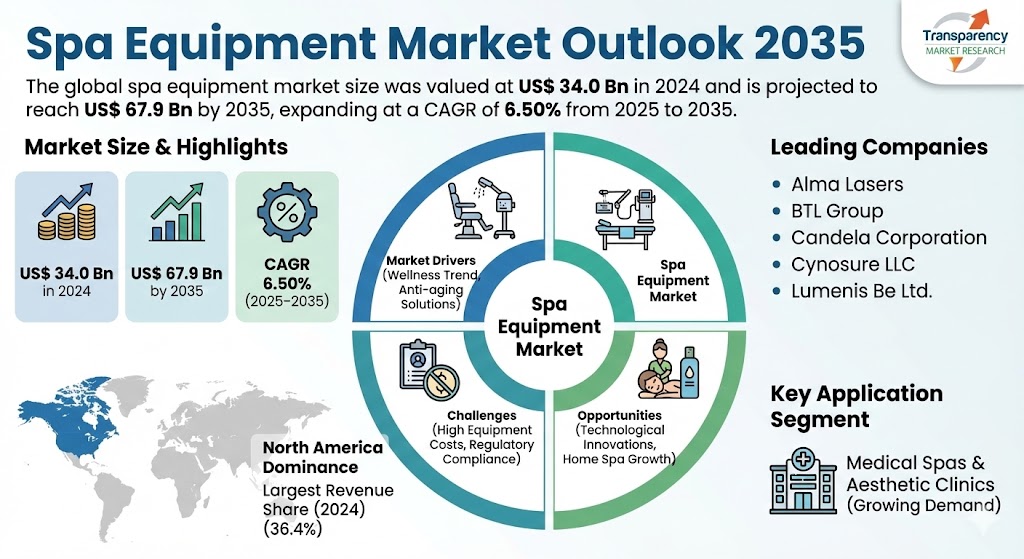
The global spa equipment market size was valued at US$ 34.0 Bn in 2024 and is projected to reach US$ 67.9 Bn by 2035
North America dominated the Spa Equipment Market in 2024, holding the largest revenue share of 36.4%.
”
WILMINGTON, DE, UNITED STATES, February 26, 2026 /EINPresswire.com/ -- The global spa equipment market was valued at US$ 34.0 Bn in 2024 and is projected to reach US$ 67.9 Bn by 2035, expanding at a steady CAGR of 6.50% from 2025 to 2035. The market is poised for sustained growth, driven by rising consumer spending on wellness and self-care, rapid expansion of luxury hospitality, increasing urban stress levels, and growing awareness of holistic health therapies.— Transparency Market Research
Spa equipment includes a wide range of products such as massage tables and chairs, facial and skincare equipment, hydrotherapy systems, steam rooms, saunas, manicure and pedicure stations, and specialized wellness devices. These products are widely used in day spas, destination spas, medical spas, hotels, resorts, fitness centers, and increasingly in residential settings.
👉 Get your sample market research report copy today@ https://www.transparencymarketresearch.com/sample/sample.php?flag=S&rep_id=86903
Market Overview
The global wellness industry has experienced robust expansion over the past decade, with consumers placing greater emphasis on mental relaxation, physical rejuvenation, and preventive healthcare. Spas are no longer considered luxury-only services but are increasingly integrated into mainstream lifestyle and healthcare routines.
Growing urbanization, demanding work environments, and rising disposable incomes are encouraging consumers to invest in wellness services. As spa facilities expand across commercial and residential sectors, demand for advanced and technologically integrated equipment continues to grow.
In addition, the increasing popularity of medical spas (medspas), which combine aesthetic treatments with clinical procedures, is boosting demand for specialized skincare and therapeutic equipment.
Key Market Drivers
Rising Wellness and Self-Care Trends
Consumers are prioritizing self-care and stress management, leading to higher spa visitation rates. Wellness tourism is expanding globally, with travelers seeking relaxation and therapeutic experiences, thereby driving demand for premium spa infrastructure.
Growth in Hospitality and Tourism
Luxury hotels and resorts increasingly incorporate spa facilities as core amenities to attract guests. The expansion of global tourism, particularly in Asia-Pacific and the Middle East, is fueling installations of spa equipment in hospitality establishments.
Increasing Disposable Income
Higher disposable incomes in emerging markets are enabling consumers to spend more on personal wellness services. This trend is particularly strong among middle-class urban populations.
Technological Advancements
Modern spa equipment integrates advanced features such as automated controls, digital interfaces, energy efficiency systems, and customizable therapy settings. Innovations in hydrotherapy, infrared saunas, and LED skincare treatments are expanding product offerings.
Expansion of Medical Spas
Medical spas offering treatments such as laser therapy, skin tightening, and anti-aging procedures are gaining popularity. This is driving demand for advanced aesthetic and dermatological equipment.
Key Developments
In August 2025, Infinity Massage Chairs announced that it had entered into partnership with HARMAN to integrate Harman/Kardon audio systems into select massage chairs.
In July 2025, Fujiiryoki, the original inventor of the massage chair, introduced the Cyber Relax Elite, a model built with Japanese engineering and a dual-robot 4D system that delivered synchronized back-to-glute massage. The chair featured an SL-Track frame, triple-action leg therapy, 86 airbags, four heat zones, zero-gravity recline, and modern additions including an 8-inch touchscreen, Bluetooth audio, wireless charging, and LED lighting.
In April 2025, CUCKOO announced a limited-time promotion on its two premium massage chairs in North America. The Renature 4D Massage Chair was priced at US$ 5,499 and offered automated body-shape recognition and multiple massage programs, while the Renature 3D Massage Chair, listed at US$ 3,999, provided heat therapy and an SL-frame design.
Regional Analysis
North America represents a mature market with strong wellness culture and high consumer spending on spa services. The presence of established spa chains and medical aesthetic centers supports steady growth.
Europe also holds a considerable share, supported by long-standing wellness traditions, thermal spas, and expanding tourism infrastructure.
The Asia-Pacific region is expected to witness the fastest growth during the forecast period. Rapid urbanization, rising disposable incomes, growing hospitality infrastructure, and increasing wellness awareness in countries such as China, India, Thailand, and Indonesia are key growth drivers.
The Middle East is emerging as a lucrative market due to luxury hospitality investments and high-end tourism projects.
👉 To buy this comprehensive market research report, click here to inquire@ https://www.transparencymarketresearch.com/checkout.php?rep_id=86903<ype=S
Competitive Landscape
The spa equipment market is highly competitive, with global and regional manufacturers offering diverse product portfolios. Companies focus on innovation, energy efficiency, ergonomic design, and customization to gain a competitive edge.
Alma Lasers
BTL Group
Candela Corporation
Collins
Cutera, Inc.
Cynosure LLC
Deka Medical Aesthetic
EarthLite, LLC
Gharieni Group
Hydrafacial LLC
Lemi Group srl
Lumenis Be Ltd.
Oakworks, Inc.
Pibbs Industries
Takara Belmont
Other Key Players
Strategic initiatives such as partnerships with hospitality chains, product launches, and expansion into emerging markets are common growth strategies. Sustainability and eco-friendly product design are becoming key differentiators as consumers increasingly prefer environmentally responsible brands.
Market Challenges
Despite positive growth prospects, the market faces challenges such as high initial investment costs for spa infrastructure and economic fluctuations affecting discretionary spending. The spa industry is also sensitive to global economic downturns and travel restrictions.
Additionally, maintaining equipment hygiene and complying with health and safety regulations require ongoing operational investments.
Future Outlook
The spa equipment market is expected to maintain consistent growth through 2035. The convergence of wellness, healthcare, and hospitality industries will continue to shape market dynamics. Technological innovations, including smart spa systems and AI-driven treatment personalization, are likely to enhance user experience.
The increasing focus on preventive healthcare and mental well-being will further drive demand for spa services and equipment. Residential spa installations and compact home wellness systems are anticipated to gain popularity among urban consumers.
By 2035, the market is projected to reach US$ 67.9 Bn, reflecting strong global demand and steady expansion at a CAGR of 6.50%. The industry’s future growth will be supported by rising wellness tourism, expanding medical spa services, and continuous innovation in therapeutic technologies.
FAQs – Spa Equipment Market
Q1. What is the projected market size by 2035?
The market is expected to reach US$ 67.9 Bn by 2035.
Q2. What is the expected CAGR during the forecast period?
The market is projected to grow at a CAGR of 6.50% from 2025 to 2035.
Q3. What factors are driving market growth?
Rising wellness awareness, expansion of hospitality infrastructure, increasing disposable income, and growth of medical spas are key drivers.
Q4. Which region is expected to grow the fastest?
Asia-Pacific is anticipated to witness the fastest growth during the forecast period.
Q5. What are the major challenges?
High installation costs and economic fluctuations affecting discretionary spending are primary challenges.
More Trending Research Reports-
Food Processing Equipment Market: https://www.transparencymarketresearch.com/food-processing-equipment-market.html
Polyvinylpyrrolidone (PVP) Market: https://www.transparencymarketresearch.com/polyvinylpyrrolidone-market.html
Air Purification Systems Market: https://www.transparencymarketresearch.com/air-purification-systems-market.html
Abhishek Budholiya - Marketing Team
Transparency Market Research Inc.
+ +1 518-618-1030
email us here
Legal Disclaimer:
EIN Presswire provides this news content "as is" without warranty of any kind. We do not accept any responsibility or liability for the accuracy, content, images, videos, licenses, completeness, legality, or reliability of the information contained in this article. If you have any complaints or copyright issues related to this article, kindly contact the author above.
