

Researchers at Sawai Man Singh Medical College and Hospital Compare Natural and Synthetic Grafts for Cranial Duraplasty
A comparative study provides new evidence to guide the choice of dural substitutes for cranial surgery
A comparative study provides new evidence to guide the choice of dural substitutes for cranial surgery
BEIJING, XICHENG , CHINA, August 13, 2026 /EINPresswire.com/ -- The brain is surrounded by a tough, protective membrane known as the dura mater, which helps contain cerebrospinal fluid (CSF) and shields the brain from infection and injury. During many neurosurgical procedures, however, the dura cannot always be closed directly because of tissue loss, trauma, or surgical removal. In such cases, surgeons perform duraplasty, a procedure that repairs the defect using either the patient's own tissue or an artificial substitute. Achieving effective dural repair is critical because inadequate closure can lead to complications such as CSF leakage, wound infection, meningitis, and prolonged hospital stays.Autologous tissues such as the pericranium (the connective tissue covering the skull) have long been regarded as the preferred material because they are naturally compatible with the body and integrate well with surrounding tissues. Synthetic substitutes, including high-density polypropylene (G-Patch), also offer advantages such as immediate availability and consistent quality, particularly when suitable autologous tissue is unavailable. Despite their widespread use, there are only a few prospective randomized studies that have directly compared the early postoperative outcomes of these two approaches.
To address this gap, a team of researchers led by Dr. Shubham Gupta from Sawai Man Singh Medical College and Hospital, India, conducted a prospective randomized comparative study involving patients undergoing cranial duraplasty at a tertiary care center in Central India. The study was conducted in collaboration with researchers from M.G.M. Medical College and MYH Hospital, India, and Max Smart Super Speciality Hospital, India. The findings were published online in Volume 12 of the Chinese Neurosurgical Journal on July 7, 2026.
"Although both natural and synthetic dural substitutes are widely used in neurosurgery, robust prospective evidence comparing their early postoperative safety has been limited. Our study sought to provide clinicians with data that could support informed decision-making during cranial reconstruction," explains Dr. Gupta.
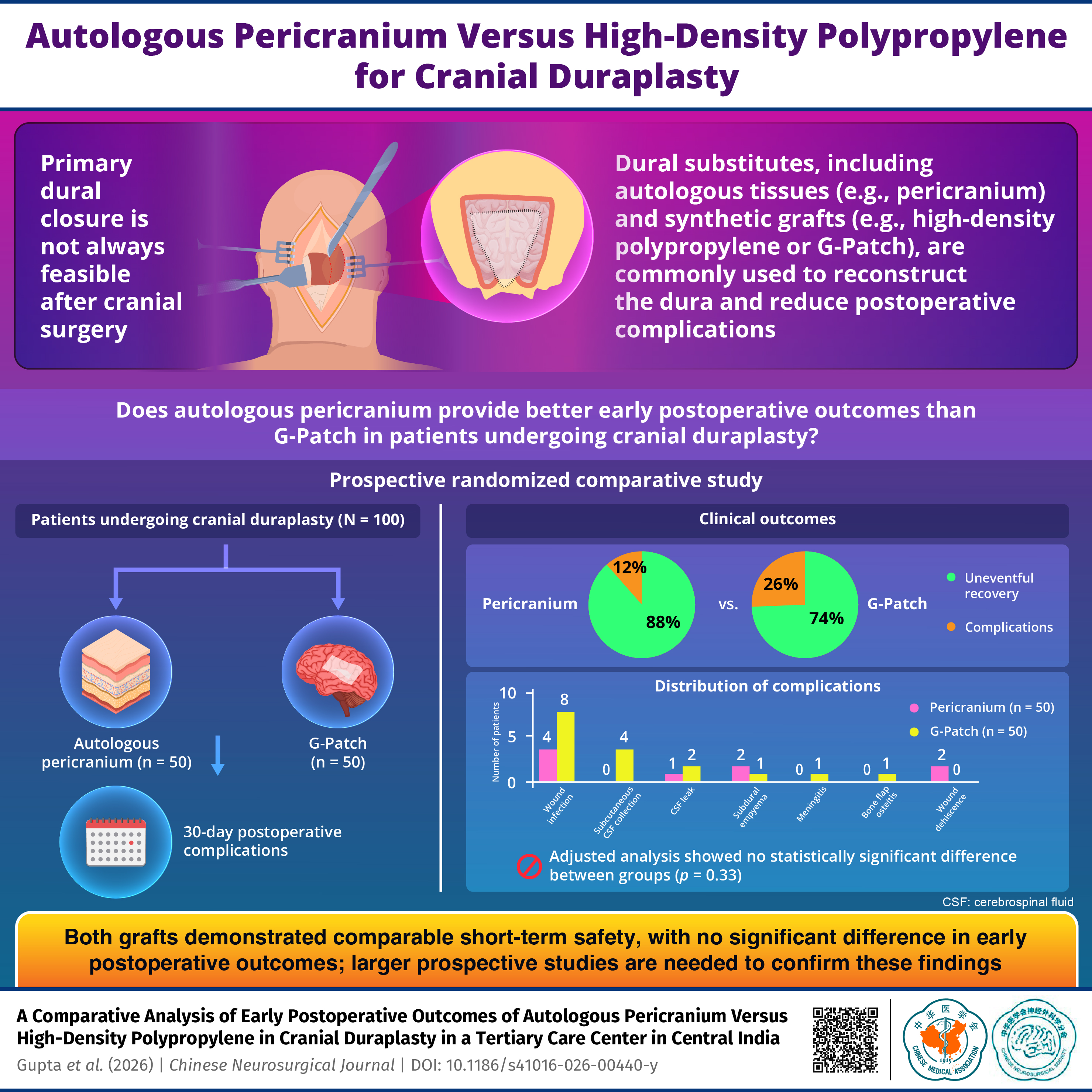
The researchers initially enrolled 121 consecutive patients undergoing cranial surgery between January and December 2021. After excluding patients who died within 30 days of surgery, because postoperative complications could not be assessed, the final analysis included 100 patients, with 50 receiving autologous pericranium and 50 receiving G-Patch grafts. Patients were monitored for 30 days after surgery for complications including wound infection, CSF leakage, meningitis, subdural empyema, wound dehiscence, bone flap osteitis, and subcutaneous CSF collection.
Most patients in both treatment groups recovered without complications. Overall, early postoperative complications occurred in 26% of patients receiving the synthetic graft compared with 12% of those receiving autologous pericranium. Wound infection was the most common complication in both groups. However, statistical analyses showed that the observed difference between the two materials was not statistically significant, even after adjusting for differences in patients' underlying diagnosis. The researchers therefore caution against interpreting the findings as evidence that one material is superior to or equivalent to the other.
"While fewer complications were observed in patients treated with autologous pericranium, the study was not sufficiently powered to establish a statistically significant difference between the two graft materials. These findings should therefore be interpreted cautiously," notes Dr. Gupta.
The study also demonstrated that both graft materials were practical options in routine neurosurgical practice. Harvesting autologous pericranium required minimal additional operative time, while the synthetic graft provided the convenience of immediate availability. The choice between the two materials may therefore depend not only on clinical considerations but also on tissue availability, surgical circumstances, institutional resources, and cost.
Importantly, the researchers acknowledge several limitations. The study involved a relatively small number of patients, included a mixed group of surgical conditions, and evaluated only short-term outcomes over a 30-day follow-up period. Differences in underlying diagnoses between the two treatment groups may also have influenced postoperative complication rates. To gain a better understanding, the researchers concluded that larger multicenter studies with longer follow-ups and disease-specific analyses will be necessary to determine the comparative effectiveness of different dural substitutes more definitively.
Highlighting the broader significance of the findings, the researchers believe that their results will provide prospective clinical evidence supporting the short-term safety of both autologous pericranium and G-Patch in cranial duraplasty. The findings may also encourage larger studies that can help establish evidence-based guidelines for selecting the most appropriate dural substitute for different neurosurgical situations.
As neurosurgery continues to evolve toward safer and more personalized care, high-quality comparative studies like the current study are essential for optimizing surgical decision-making. By providing prospective evidence on two widely used dural substitutes, this study contributes valuable information that could help improve patient outcomes while informing future research and clinical practice in cranial reconstruction.
Reference
Title of original paper: A comparative analysis of early postoperative outcomes of autologous pericranium versus high‑density polypropylene in cranial duraplasty in a tertiary care center in Central India
Journal: Chinese Neurosurgical Journal
DOI: https://doi.org/10.1186/s41016-026-00440-y
About Sawai Man Singh Medical College and Hospital, Jaipur, India:
Established in 1947, Sawai Man Singh Medical College and Hospital (SMS Medical College), Jaipur, is one of India's premier government medical institutions and the 15th center for medical education established in the country. Affiliated with the Rajasthan University of Health Sciences, the institution offers undergraduate, postgraduate, and super-specialty medical education while delivering advanced tertiary heal
thcare through its network of attached teaching hospitals. With one of India's largest outpatient services, SMS Medical College is committed to excellence in patient care, medical education, and biomedical research.
Website: https://medicaleducation.rajasthan.gov.in/smsjaipur/#/home/dptHome
About Dr. Shubham Gupta from Sawai Man Singh Medical College and Hospital, India
Dr. Shubham Gupta (MBBS, MS General Surgery, MCh Neurosurgery) is a neurosurgeon and Assistant Professor in the Department of Neurosurgery at Sawai Man Singh Medical College and Hospital, India. His research focuses on advancing evidence-based neurosurgical practice, with interests spanning cranial surgery, neuro-oncology, traumatic brain injury, and spine disorders. He has authored more than 12 peer-reviewed publications investigating clinical outcomes and prognostic factors in neurosurgery. Through his clinical practice and research, Dr. Gupta is committed to improving surgical decision-making and patient outcomes while contributing to innovations in neurosurgical care.
Funding information
The authors report no involvement in the research by the sponsor that could have influenced the outcome of this work.
Dr. Shubham Gupta
Department of Neurosurgery, Sawai Man Singh Medical College
email us here
Legal Disclaimer:
EIN Presswire provides this news content "as is" without warranty of any kind. We do not accept any responsibility or liability for the accuracy, content, images, videos, licenses, completeness, legality, or reliability of the information contained in this article. If you have any complaints or copyright issues related to this article, kindly contact the author above.
